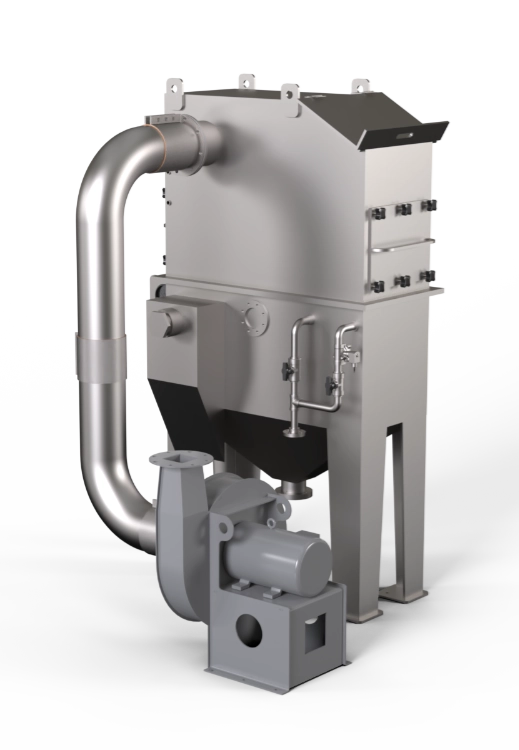

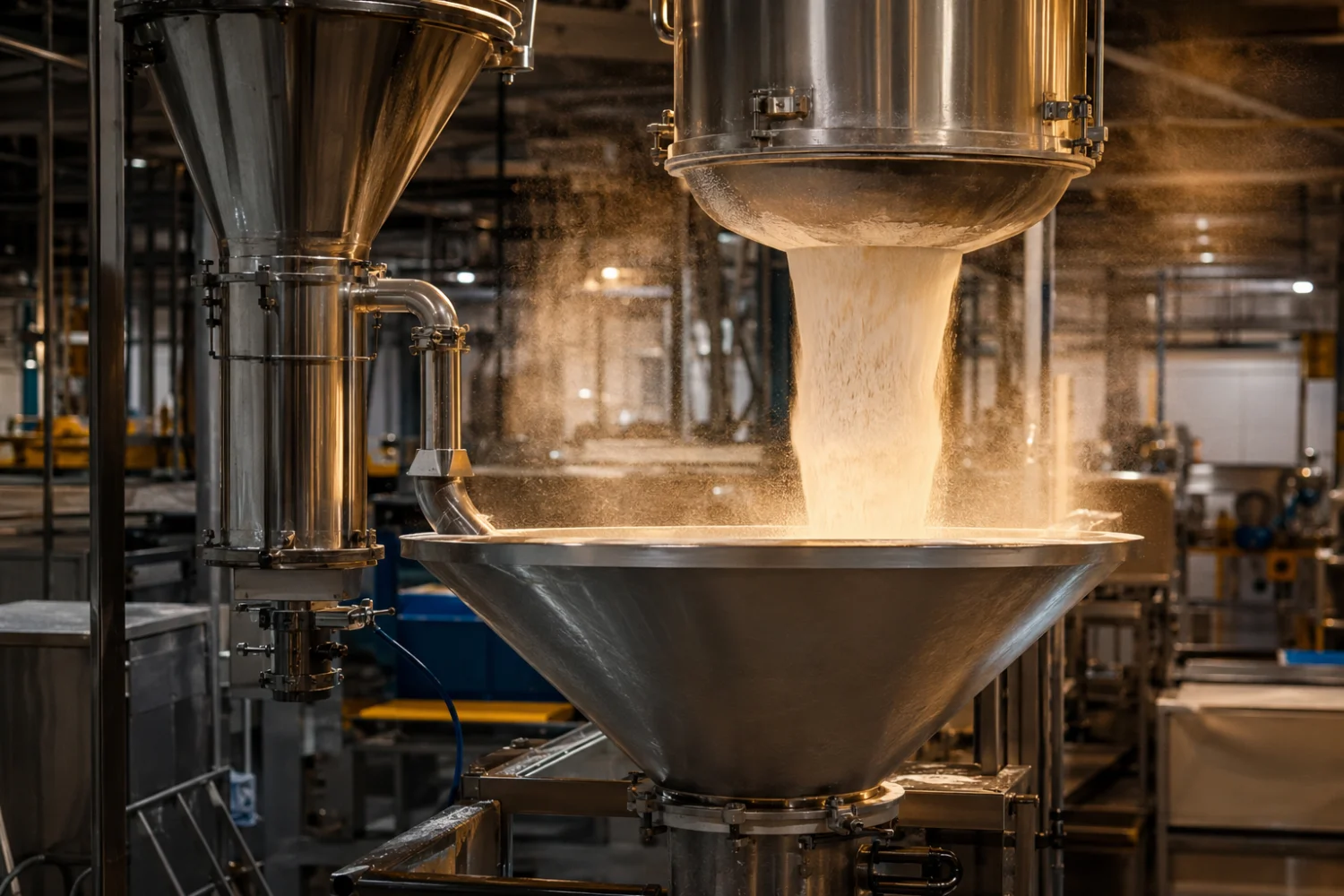
In confectionery production, consistency is everything.
Whether you’re handling sugar, powdered coatings, or ingredients, even small process issues can have a noticeable impact. Material that doesn’t flow properly, product that clumps unexpectedly, or equipment that requires frequent intervention—these are the kinds of challenges that slow production and increase operational frustration.
Often, the root cause isn’t a single failure. It’s the gradual impact of aging equipment combined with the demands of modern production and safety expectations.
The Challenge: Moisture, Buildup, and Aging Equipment
Sugar-based materials are particularly sensitive to their environment.
When moisture enters the process—even in small amounts—it can quickly lead to:
- Clumping inside filter receivers
- Material buildup along walls and discharge points
- Bridging that interrupts consistent discharge
- Increased manual intervention to keep product moving
- Sealing surfaces that no longer prevent environmental infiltration
- Access points that are difficult to clean or maintain
- Geometry that was not designed for long-term handling of cohesive materials
In many confectionery operations, these issues develop gradually. What starts as occasional buildup can turn into frequent maintenance, reduced throughput, and inconsistent product quality.
Additionally, safety expectations have evolved. Dust hazard analyses often identify gaps in legacy equipment—especially when handling combustible materials like sugar.
The Approach: Addressing Performance and Reliability Together
One effective way to resolve these issues is by evaluating both performance limitations and safety considerations at the same time.
In some cases, targeted updates can extend the life of existing equipment. In others, replacing outdated assets provides a more reliable long-term solution.
The key is focusing on the areas that directly impact daily operation.
1. Improving Sealing to Protect Product Quality
For confectionery applications, sealing is critical.
If ambient moisture enters a receiver, it can quickly affect how sugar behaves—leading to clumping, sticking, and inconsistent flow.
Upgrading sealing designs can:
- Prevent moisture intrusion
- Maintain product consistency
- Reduce buildup inside equipment
2. Supporting Operators with Better Access
When sugar begins to bridge or accumulate, operators often need to intervene.
If equipment does not support easy access, this becomes time-consuming and inconsistent.
Adding well-placed access points can:
- Allow operators to quickly break up material buildup
- Reduce downtime during production
- Improve overall process control
These changes don’t alter the material itself—but they make the system easier to manage under real operating conditions.
3. Optimizing Geometry for Sugar Handling
Material flow in confectionery applications is closely tied to equipment geometry.
Sugar, flour, and similar materials can behave unpredictably, especially when exposed to moisture or compaction.
Improving geometry—such as increasing cone angles—can:
- Promote more consistent discharge
- Reduce bridging and hang-up
- Minimize the need for manual intervention
Expanding the Solution: Updating Safety and System Design
As performance issues are addressed, many confectionery manufacturers also take the opportunity to align equipment with modern safety expectations.
Dust hazards are a known concern in sugar handling environments. As a result, facilities often evaluate:
- Explosion mitigation strategies
- Isolation at key process points
- Long-term maintenance requirements for safety systems
In some cases, replacing equipment allows these updates to be integrated directly into the design—rather than retrofitted later.
Selecting solutions that balance safety and simplicity is often a priority. Passive systems, for example, can reduce ongoing maintenance while still meeting safety requirements.
Designing for Real-World Confectionery Operations
In active facilities, upgrades must work within existing processes.
New equipment needs to integrate with:
- Established production lines
- Existing layouts and connection points
- Operators who are familiar with current systems
The most effective solutions recognize these constraints.
Instead of forcing major process changes, they focus on:
- Maintaining familiar configurations
- Improving key performance areas
- Simplifying installation and startup
This approach reduces disruption while still delivering meaningful improvements.
The Result: A More Reliable Confectionery Process
Improved Product Consistency
Reduced Buildup and Bridging
Less Operator Intervention
Enhanced Safety Alignment
Simplified Maintenance and Operation
Key Takeaways for Confectionery Manufacturers
If your process involves sugar or similar materials, and you’re experiencing buildup, inconsistent flow, or increasing maintenance requirements, the cause is often tied to equipment design and environmental control.
Addressing these challenges may involve:
- Improving sealing to prevent moisture intrusion
- Updating geometry to support consistent flow
- Adding operator-friendly access points
- Aligning equipment with current safety requirements
- Evaluating when replacement provides more value than continued modification
In many cases, targeted updates—or strategic equipment replacements—can restore reliability, improve product quality, and make your system easier to operate over time.
At HaF Equipment, we work with confectionery manufacturers to evaluate these types of challenges and develop practical solutions that fit within existing operations. Whether the need is improving sealing, updating equipment design, or aligning with current safety requirements, our team focuses on applying real-world experience to create systems that are easier to operate, maintain, and scale over time.
About HaFSBX
HaFSBX has over 50 years of providing proven solutions to dry and liquid ingredient handling challenges.
We design turnkey systems for projects of all sizes. Our team understands our customers’ concerns and takes the time to listen, develop a plan, and communicate along the way. If you need someone you can trust and want to eliminate the stress of managing the details of your next project, contact us today to discuss your next project and how our team can help.
About the Author – Luke Schwirtz
Luke Schwirtz is a Project Engineer at HaFSBX. He has a strong track record of implementing cost-effective automation solutions and leading process improvements that enhance performance, increase efficiency, and support overall quality across projects.