
U.S.A. Based Manufacturer.
Supporting Businesses Worldwide.

FIND US: 1140 Gervais Avenue, Maplewood, MN 55109

CONTACT: (651) 653-5098
sales@hafequipment.com

HāF Equipment Acquires Semi-Bulk Systems, Expanding Ingredient Handling Capabilities

HāF Equipment Acquires Semi-Bulk Systems, Expanding Ingredient Handling Capabilities…Read More

Is Your Industrial Dust Collector Equipment Sufficient?

Industrial Dust Collector The Right Equipment

An industrial dust collector is a device that helps to control industrial dust. It works by capturing dust particles from the air and then either storing them or disposing of them. There are many different types of industrial dust collectors available, and the best type for a particular application will depend on the nature of the dust and the industrial process. For example, cyclonic separators are often used for heavy-duty applications such as sawdust removal, while baghouses are better suited for capturing fine particles. Proper industrial dust handling and collection is essential for maintaining a safe and productive workplace.

HaF Equipment manufactures some of the most reliable and affordable industrial dust collectors on the market. Our factory dust collectors are designed to meet the specific needs of your workplace, and our team is always available to help you choose the right model for your needs. HaF Equipment has the perfect solution for you whether you need a small, portable unit or a larger machine for your particular industrial dust collection needs.

Read about the different types of industrial dust collectors that HaF supplies in our article, Industrial Dust Collection: Why The Right Equipment Matters

Typical material handling equipment that require dust collection control:

Bulk Bag Filler

Bulk Bag Filler is a standard piece of equipment in manufacturing. It is used to package a wide range of dry powders and granulated and flaked materials into bulk bags (also known as totes, super sacks, or big bags). They are engineered for bulk material processing and packaging applications requiring high-performance operation, where reliable and repeatable duty cycles, rates, accuracy, and equipment effectiveness are crucial. They can be designed to operate as either manual or automated systems. 

Using HaF Bulk Bag Fillers, the operator loads a bag into the filler station and inflates the inflatable boot, creating a seal to hold the bag in place for filling. The filler head is equipped with a vacuum port connected to a dust collection system (such as the systems that HaF supplies!) and is used to pull out the dust created while filling. Inside the filler head, an internal baffle goes below the vacuum port, causing the product to fall into the bag while forcing the air to make a 180 turn. This pulls the air out of the bag without pulling any product.

Portable Dust Collector - HaF Eqiupment


Portable Dust Collector – HaF Equipment

Truck Unload Systems

Unloading a semi-trailer of raw ingredients into a storage silo is another process that requires dust collection. The semi-trailer often comes equipped with an onboard positive displacement blower package that pressure-conveys product into the silo. Because both product and air are being blown into the silo, a lot of dust is created and needs to be pulled out of the system. 

HaF has designed an operator-friendly bin vent that is used on top of the silo to create an effective filtration point where powder stays in the system and clean air exits the bin vent. The bin vent is a dust collection apparatus because it is used to cleanly release the air from within the silo back into the atmosphere. This is achieved by using filters that stop the product from leaving as the air escapes. The bin vents are sometimes equipped with a fan mount. This allows a fan to be added later for applications where air needs to escape faster. This system keeps the dust from escaping out of the top of the silo. Once an unload cycle is complete, the filter bags are back pulsed with compressed air to keep them clean and clear of dust.  System Integration Unloading and Silo Systems.

Bulk Bag Unloaders

Bulk Bag Unloaders are used to unload product from super sacks (also known as big bags or totes) into the system. Untying a bulk bag can be a dusty process for operators, and like the bulk bag filler, it is important to contain the dust so that it does not enter the plant or the atmosphere. The bulk bag unloader has either a receptor tube or a discharge spout with a glovebox for operator access. Which type depends on the application and customer preference. Again, like the bulk bag filler, this is equipped with a vacuum port connected to a central dust collection system that HaF can design and supply. The HaF Dust Collection System is used to pull out the dust created when the operator has the door open. There needs to be a slight draft so that powder does not fly into the face of the operator. HaF has included a custom-designed baffle to prevent the product and the bag from being pulled in. The dust collection system is activated when the operator opens the door and disengages the safety sensor on the discharge spout. It turns off when the door is closed so that product can resume flowing. In this way, HaF has automated the dust collection process to ensure a clean environment for operators.

Bag Break Stations

To add 50-lb bags of material into the system, operators use Bag Break Stations. Bag Break Stations require effective dust collection when the operator is opening bags. HaF has designed the bag break stations to work with dust collection systems so that a slight vacuum is pulled to prevent dusting while operators empty bags into the hopper. Once the operator closes the door, the dust collection system stops, and the filter bags are pulsed to remain clean and clear of dust. 

Summary:

Dust collection is a critical step in the manufacturing process. By collecting dust before it has a chance to enter the atmosphere, factory dust collection systems help to keep the air clean and safe to breathe. In addition, dust collection systems help prevent the spread of dust particles throughout the factory, which can lead to equipment malfunctions, production delays, and, worse, plant explosions. By investing in high-quality dust collection systems, manufacturers can help protect their workers and their bottom line

Contact a HaF account manager today to discuss your options.  

You may also like:

Airlocks and Pneumatic Conveying

Airlocks and Pneumatic Conveying

by Dan Fried and Devon DeJong

Does your mind go straight to the scene of your favorite Sci-Fi movie when someone mentions airlock systems– where the hero (or villain) is trapped between safety and being sucked out into deep space at the press of a button? We like a good science fiction movie, too, but airlocks in pneumatic conveying get us just as excited!  

What are airlocks? An airlock is a compartment with doors that can be sealed against pressure which permits the passage of people and objects between environments of differing pressure or atmospheric composition while minimizing the change of pressure in the adjoining spaces and mixing of environments. The airlock technology consists of a relatively small chamber with two airtight doors in series which do not open simultaneously. (Source) 

In pneumatic conveying, airlock systems are the passageways that bulk materials use to move between environments consisting of different pressures, gases, or both, with the goal being to minimize pressure loss and to prevent the gases from mixing. (In pneumatic conveying, airlocks are used for passage between various environments of different materials like gases, or different pressures, or both, to minimize pressure loss or prevent the gases from mixing). Airlocks are a critical component of pneumatic conveying designs. When applied to conveying, the objective is to move bulk material across a pressure differential; low to high (Pressure Conveying) or high to low (Vacuum Conveying). 

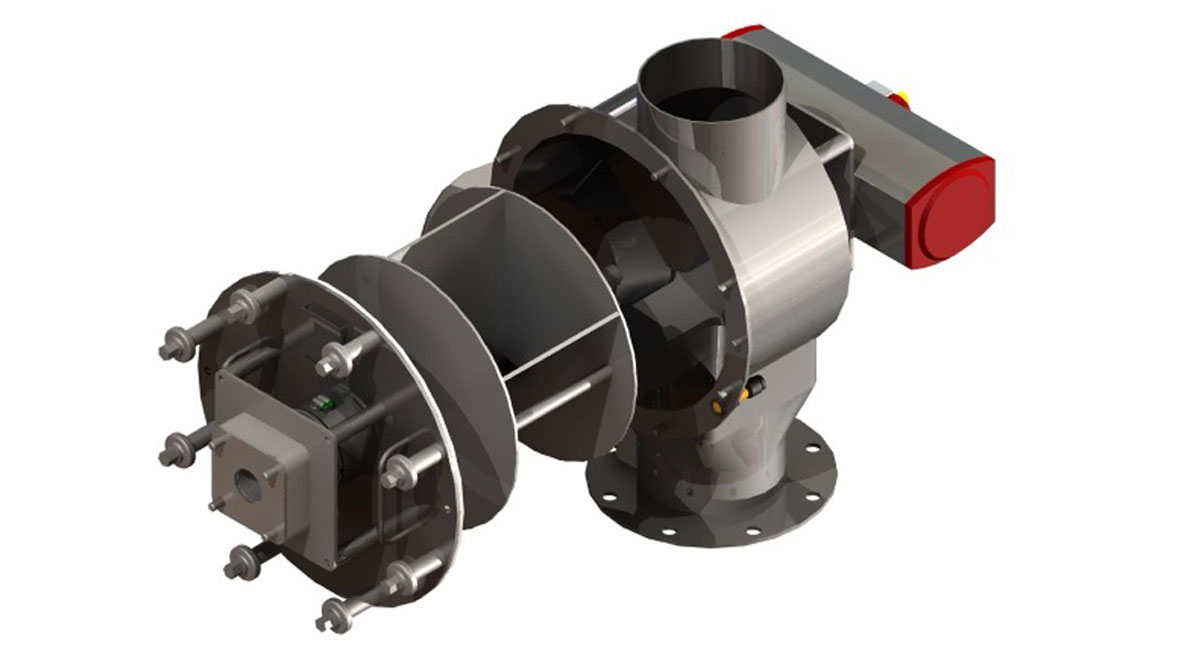
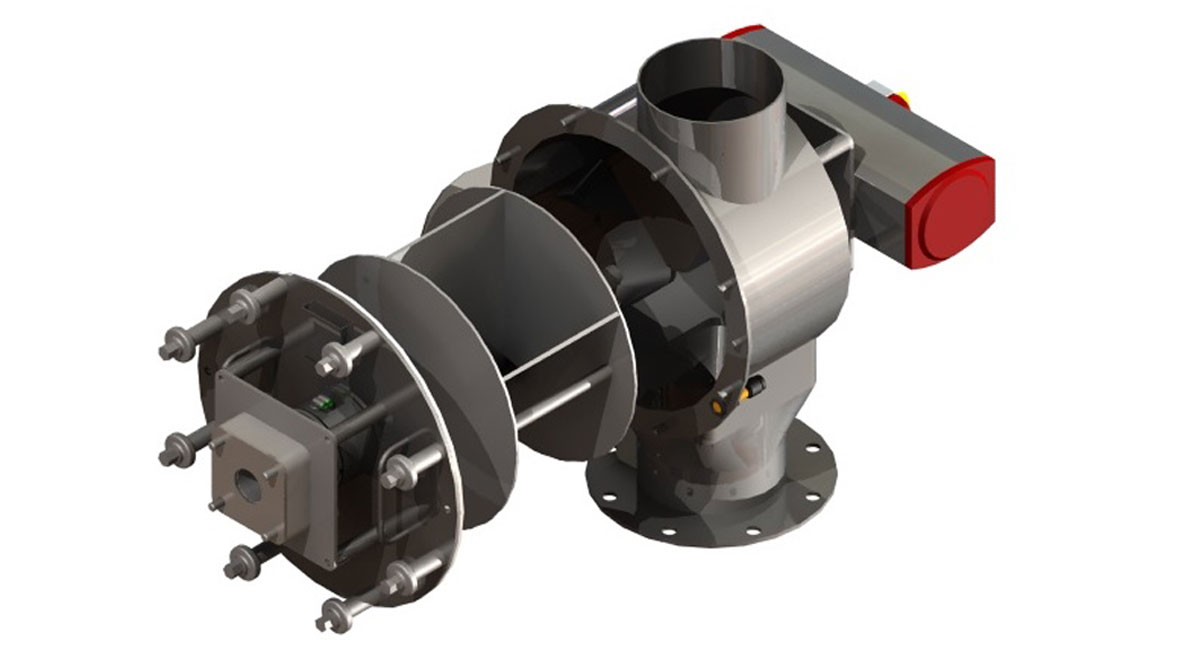
How airlock technology works can sound complex; however, the design is simple. When a product drops into a pocket on the top, the rotor spins and drops the product out the bottom. The rotor has VERY tight tolerances with the housing to prevent air or the product from blowing past the rotor tips. (A typical airlock will come with a rotor tip-to-housing clearance of between .004” and .007”; Once that clearance is above .0079″ it is no longer NFPA compliant). An airlock prevents air leakage across the pressure differential.

Airlocks Used in Bulk Material Handling

Drop-through airlock. What is beneficial about this airlock is that the cost is lower because it is more widely available. The downfall to the drop-through airlock is the head height. 

Drop-through airlock with rails. Customers appreciate this airlock because it is operator and maintenance-friendly. The drawback to this airlock is the cost on the application’s front end. 

Blow-through airlock. Compared to the drop-through airlock, the blow-through lock is preferred because of its head height and the feature that no pick-up shoe is needed. The blow-through airlock is avoided at times because of the cost and the few options it provides.

Airlocks and NFPA Compliance

Airlock systems are one of the most important components of an equipment’s success. Knowing the application will determine whether the airlocks need to be NFPA Compliant.

The National Fire Protection Association is an organization that is devoted to eliminating death, injury, property, and economic loss due to fire, electrical and related hazards. The NFPA Codes & Standards states that the airlock has a minimum of 8 vanes. At least two vanes must always stay in contact with each side of the housing, and the vanes must be at least 3mm thick. This helps keep flames contained to the rotor pocket if there is an explosion. Plastic or rubber tips are not NFPA compliant, as they will not hold up to the heat of an explosion. It’s also important to know that rotor-to-housing clearance must stay below .0079″ (0.2mm).

SELECTING AN AIRLOCK

Many factors go into selecting the right airlock for a project. Knowing the environment to which the airlock will be exposed is a vital consideration.

  • Temperature is a key factor, so it is important to know if the airlock will be indoor or outdoor, and the temperature of the material being conveyed.
  • Pressure above or below the throughput needs makes a difference.
  • Product details surrounding the airlock need to be considered to select the proper airlock; i.e. bulk density, angle of repose, flowability, abrasiveness and explosiveness are all product characteristics that can affect the airlock.

When questioning which airlock system is best suited for a project, consider the airlock itself; body type, body material, rotor style/material, inboard vs. outboard bearings, and gland vs. air purge shaft seal play into what airlock will perform the best.

There are many options to rotary airlocks.

  • The shallow pocket types reduce the volume per requirement and are generally used on filters, cyclones and silos.
  • A staggered pocket rotor has a continuous and uniform flow to provide a more accurate rate of material flow.
  • Fine Dosing rotors are beneficial when feeding or discharging fine powders, materials or granules that are contained in hoppers and silos.
  • A scalloped rotor is best suited for sticky materials or food-grade applications.
  • Flexible tip rotors are helpful when trying to avoid jams in the valve and are more suited for dust filters than food-grade applications.
  • Consider an adjustable rotor when handling more abrasive material.

Rotary airlocks can also offer a variety of features.

A low-cost feature with a high reward is a shaft seal air purge. A shaft seal air purge will prevent material from entering the seals and bearings.

A Zero Speed Switch is a valuable feature where it alerts the system if the rotor stops spinning, jams, or breaks.

Although they have a high price point, Slider Rails allows access for cleaning and maintenance.

The material and the coating of an airlock is critical. Nickel plating, chrome plating, and tungsten coating all help prevent premature wear of the airlock. 

Factors, options, and features of the airlock system can be overwhelming. Working with a skilled team of knowledgeable engineers in the field can help. With over 25 years of experience, HaF Equipment is that team Ready To Connect!

Summary:
HaF Equipment is here to assist you with which application would benefit from pneumatic conveying; and seeing is believing. So, contact a HaF account manager today to see what options we can provide you. 

Facebook
Twitter
LinkedIn
Email

Pneumatic Blending – Back to the Basics

Pneumatic Blending

by: Jared Beaupre

Companies struggle with keeping their material handling equipment clean. Especially the inside of the equipment. For example, have you ever tried to clean an industrial-sized mixer, like a ribbon blender? With most industrial equipment, like mechanical mixers, it can be labor-intensive, and dangerous, to ensure the unit is effectively cleaned and that the backsides of all the mixing paddles are clean. The tiny crevices in the design are out of sight but not out of mind. But what if we told you that you could blend your dry powders without a mechanical-oriented mixer? Imagine an industrial blender that is just as clean and simple as an empty hopper and cone! At HaF Equipment, we have the solution: Pneumatic Blenders!

Using simple compressed air, a pneumatic blender pulses a bubble of air into the centerline of the cone. That air pushes a column of the dry material upward, like taking a core sample or cross-section of the stratified material. As the column of material moves upward, the air expands and accelerates to throw that material into the headspace of the hopper. It is this motion that creates the mixing action.

The motion of the material also creates an aeration effect that creates a fluidized state for the material. When in a fluidized state, the material is free-flowing. So, as that column of material lifts, the remaining material around the side walls freely flows down and replaces the material blown upward. The mixing of powders happens quickly, with no mechanical friction.

When the Pneumatic Blending Process is Best

Pneumatic blending isn’t for all applications, however. It is best when an extremely quick and accurate blend is needed. Since the blending action isn’t a “folding over” or “mass cutting,” the blend is extremely homogenous in a very short period. Rather than a blend measured in tens of minutes, most pneumatic blends can be accomplished in less than a minute. All of this is, however, dependent on the material blended. Material that is easily fluidizable, such as flour, glass bubbles, or powders for ceramics, work extremely well. Materials that are large particles, such as stones or nuts, are not good candidates since the air tends to flow through the material, not allowing the column of material to lift.

Comparing Blender Types

  • RIBBON blender.

    A Ribbon Blender typically has a U-shaped horizontal trough and then a custom fabricated ribbon agitator that spins to mix powders. The pros to the ribbon blender are that it operates at a cost-effective price point and offers high capacity.  Pneumatic blending can also work with large tonnages.  Unfortunately, the ribbon blender does not fill all the way and is often left with dead space (unused space). Another downfall to the ribbon blender is that it can be dusty, especially around the mechanical seals.  Pneumatic blending is sealed tight and is a simple hopper in concept.  The ribbon blender also tends to have a larger footprint and can sometimes damage the product in production.  Pneumatic blending is essentially a simple hopper and cone with air pistons in the cone.  The pneumatic blender is gentle in regard to damaging product.  It uses compressed air, not stainless-steel agitators.

  • PADDLE blender. A mixing paddle blender uses a custom fabricated paddle, typically mounted on a shaft, which can be inserted on the shaft end into the end of a motor drive assembly.  The paddle blender offers large capacity, with reduced RPM. On the flip side, the paddle blender is not proven to be efficient, and the gearbox located on the top of the vessel can be a hindrance. 

  • TUMBLER or V blender.

    V blenders are rotary mixers, also called tumble blenders. Just like how it sounds, the shape of the machine is a “V”.  The V is formed by welding together two cylinders.  The whole unit rotates allowing the powders to mix.  This is called diffusive (or dispersion) mixing. In diffusive mixing, the particles of solids move randomly, typically rolling down when their container is rotated. The motion is driven by gravity and falling particles.  There is no mechanical agitator or ribbon.

    There are no agitators inside the V blender, all the movement of the powder comes from gravity and the rotation of the shell. Since there is no agitator, it will perform “ok” with free-flowing solids, but it is less effective with cohesive powders. 

    The benefit of the V blender is that is has smooth internal surfaces that results in a more sanitary design.  But this is the same with pneumatic blending where the inside of the vessel is sanitary smooth.

    You get the clean vessel with the pneumatic blender as needed in pharmaceuticals, and the pneumatic blender is ultra-sanitary. The tumble blender tends to be more expensive, offers low capacity, and does an “ok” job with mixing.

Pneumatic Blender

Pneumatic Blender Flexibility – Powders & Liquids

The applications and variations of the Pneumatic Blender are vast and can be used for varying applications depending on the industry. Coatings or flavor additions are a great way to use pneumatic blending with liquids.  Pneumatic blenders can also be used for fluidizing silos and aid in silo discharge of ingredient powders.

When the pneumatic blender is put at the bottom of a dense phase conveyor vessel, it can receive the powders in, blend, and dense phase convey the powders long distances.  This is extremely helpful when you want to blend powders in a powder dedicated room, and then send the blended batch of powders to a production line elsewhere in the manufacturing facility.  This set up is very flexible.

Lastly, this system can utilize inert gas to blend combustible powders.

Pneumatic Blender - HaF Equipment

Summary:
HaF Equipment is here to help you determine which application would benefit from pneumatic blending; and seeing is believing. So, contact a HaF account manager today to see what options we can provide to test the blender. We can do this in our facility with your material, or directly at your facility to give real-time results with as many in-plant conditions as possible. At HaF, we are Ready to Connect!

CONTACT US today to discuss your pneumatic blending equipment needs. 

LIKE THIS ARTICLE? PLEASE SHARE.

Share on facebook
Share on twitter
Share on linkedin
Share on email
 

About HaF Equipment

HaF is a Minnesota-based company with employees spread out across the USA and capabilities world-wide. We’re ready to support your manufacturing industry needs no matter where you live or what type of industry – we’ve got our finger on the pulse Ready to Connect. 

For more information about how we can help you meet your goals, don’t hesitate to call us at (651) 653-5098, or complete the Contact Form on our website.

Keep It Clean: HaF’s Gravity Divert Valve

Gravity Divert Valve

HaF Equipment’s latest gravity divert valve is an ideal solution for those who need to upgrade their aging system with modern technology. This sanitary diverter valve will increase efficiency and help prevent expensive downtime due to inefficient and outdated systems. The gravity divert valve is built for sanitary applications and is designed and built to the United States Department of Agriculture (USDA) build standards.

The focus for the gravity divert valve is on sanitary design and to provide an easy to clean divert valve positioned in the vertical orientation so that powder can flow and drop into either of two locations.

Using proven HaF design methods developed over 25 years, the gravity divert valve is part of our tool-free-quick-take-apart® designs developed for ease of cleaning. The main body of this sanitary diverter valve can be disassembled and wiped down because there are no hidden crevices. The sanitary ferrule connections allow for a clamp to easily be removed, gaining access to clean the connections and easily remove the gravity divert valve for cleaning.

Gravity Divert Valve for article

Custom Gravity Divert Valve

Although the most recent Gravity Divert Valve that HaF configured has 6-inch diameter chutes, our team is innovative. HaF can design custom down chutes for whatever application the customer needs. Its framework is solid and is structured with a heavy-duty actuator. This flow direction valve has a “Y” Divert Split Configuration with a 60-degree offset. Precisely designed, the gravity divert valve is built with a dual coil solenoid and has a Proximity Limit Switch with a Cable.

Gravity Divert Valves are available in different sizes to mix and match components depending on the customer’s needs and specifications.

About HaF

HaF is a Minnesota-based company with employees spread out across the USA and capabilities world-wide. We’re ready to support your manufacturing industry needs no matter where you live or what type of industry – we’ve got our finger on the pulse Ready to Connect. 

For more information about how we can help you meet your goals, don’t hesitate to call us at (651) 653-5098, or complete the Contact Form on our website.